Old World and New World Wines
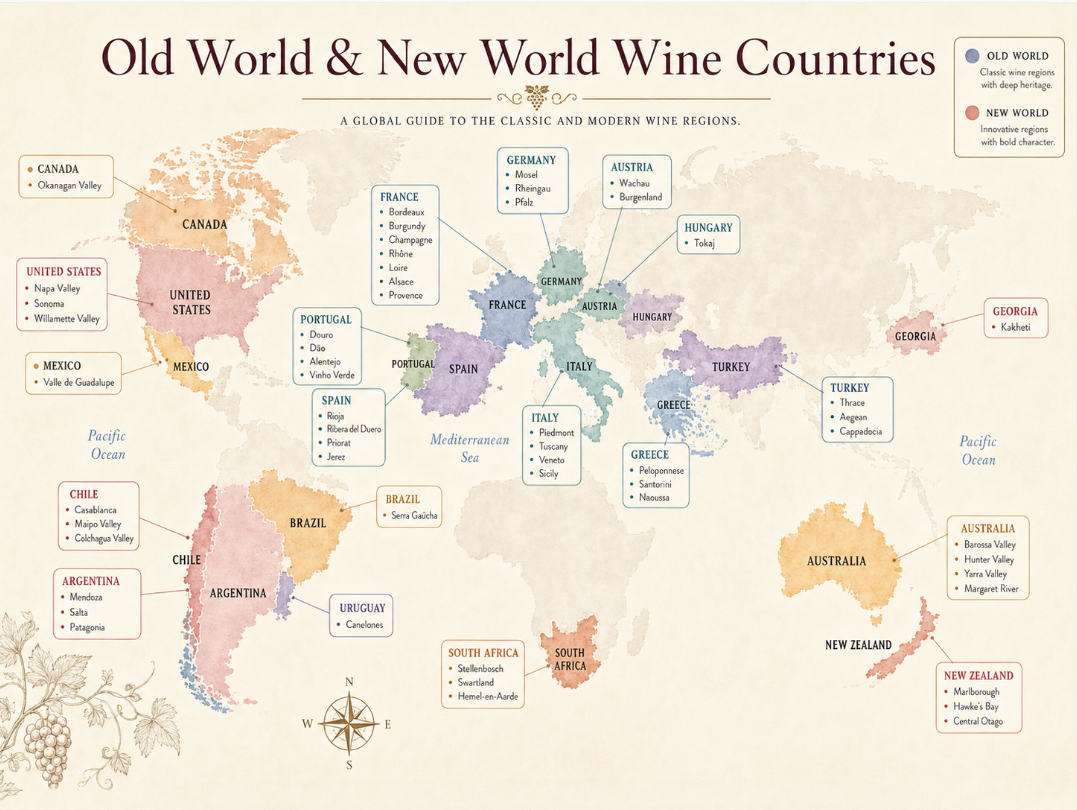
The world of wine is shaped by two great traditions: the Old World and the New. The Old World belongs to Europe, where vines have grown for millennia in the sunlit valleys of France, Italy, Spain, Portugal, Germany, Austria, Greece, Hungary, Turkey, and Georgia. These are lands where wine is an inheritance rather than an industry, where grapes such as Cabernet Sauvignon, Merlot, Pinot Noir, Syrah, Sangiovese, Nebbiolo, Tempranillo, Grenache, Chardonnay, Sauvignon Blanc, Riesling, and Chenin Blanc are guided by the hand of history and the voice of the soil. Their wines speak softly, shaped by balance, structure, and a reverence for place.
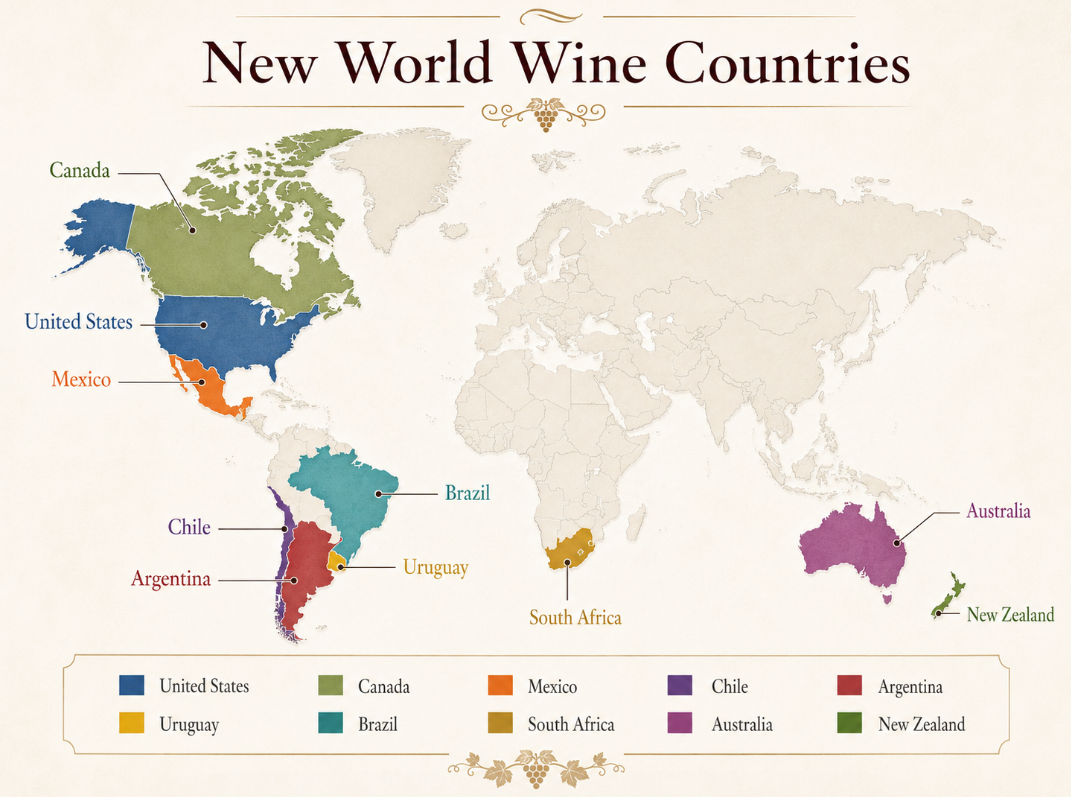
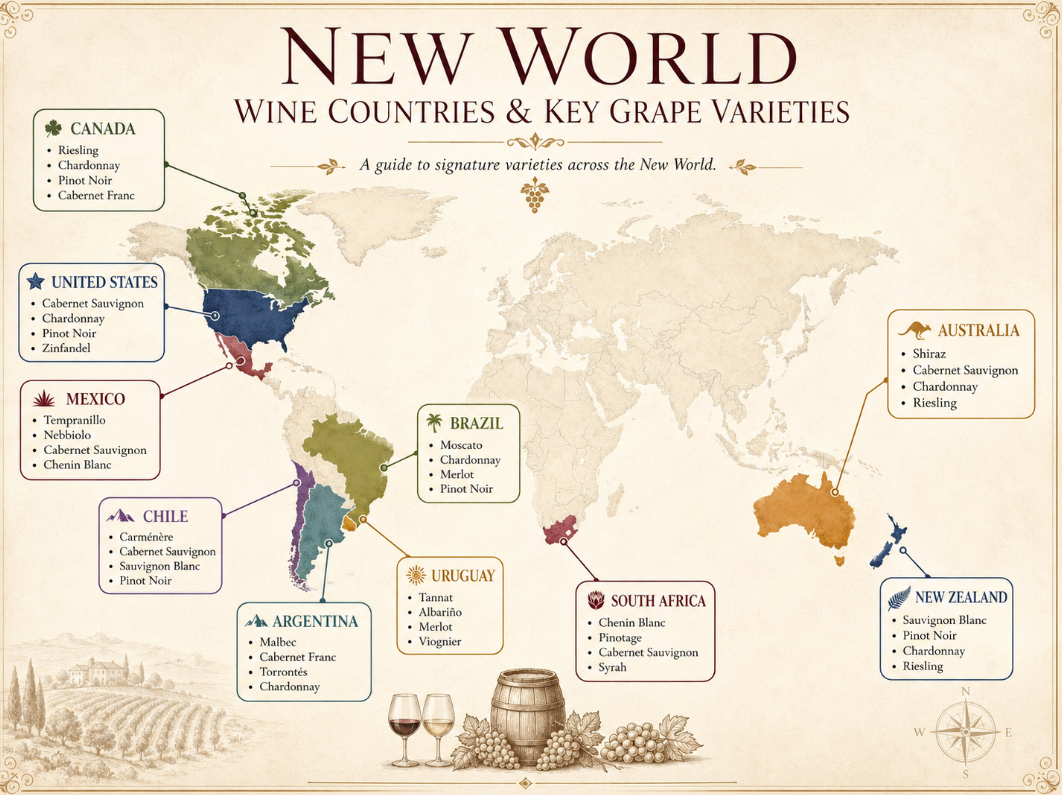
The New World, in contrast, stretches across distant continents, where vineyards flourish in the warmth of California, the wide skies of Argentina and Chile, the golden coasts of Australia, the emerald slopes of New Zealand, and the rugged beauty of South Africa and Canada. Here, winemaking is an act of exploration, and grapes such as Malbec, Zinfandel, Shiraz, Viognier, and Semillon are transformed into wines that gleam with generosity and sunlight. The Old World remembers, the New World reinvents, and together they remind us that every bottle is both a memory and a beginning.

Old World wines are the quiet voice of civilisation, the liquid memory of lands where vines have grown for thousands of years. They are born from Europe and the Mediterranean, where wine became more than nourishment; it became ritual, culture, and art. Every vineyard carries a lineage that reaches back to ancient farmers and patient families who treated the soil with reverence. These wines are not made to astonish with power but to move the senses through balance and grace. They are shaped by time, by humility, and by the belief that beauty emerges when one listens to nature rather than commands it.
The character of Old World wine is one of elegance and restraint. It favours poise over exuberance and complexity over sweetness. The flavours are often subtle, revealing layers of herbs, earth, flowers, and mineral tones before the fruit appears. They age gracefully, gaining depth and perfume as years pass, showing that true refinement is born from patience.
The grape varieties of the Old World are guardians of heritage. In France, Italy, Spain, and beyond, each variety has adapted perfectly to its home. Cabernet Sauvignon and Pinot Noir speak with the clarity of limestone and clay. Sangiovese, Nebbiolo, and Tempranillo express warmth, structure, and fragrance shaped by centuries of cultivation. Riesling, Assyrtiko, and Narince reveal purity and light, each one capturing a distinct geography and soul. These grapes are not manipulated to please fashion; they are grown to express place.
The terroir of the Old World is the invisible author of every wine. Soil, sunlight, rainfall, and the patient rhythm of the seasons all shape its voice. Limestone gives refinement, clay offers depth, volcanic ash creates energy, and gravel brings elegance and perfume. Each vineyard has its own language, and the winemaker simply translates it. Terroir is not an idea but a living force, binding the taste of wine to the earth that bore it.
Old World wines invite contemplation. They are not hurried, and they do not need to shout. They ask only to be understood slowly, as one might understand a poem. To taste them is to taste history itself; patient, complex, and endlessly alive.
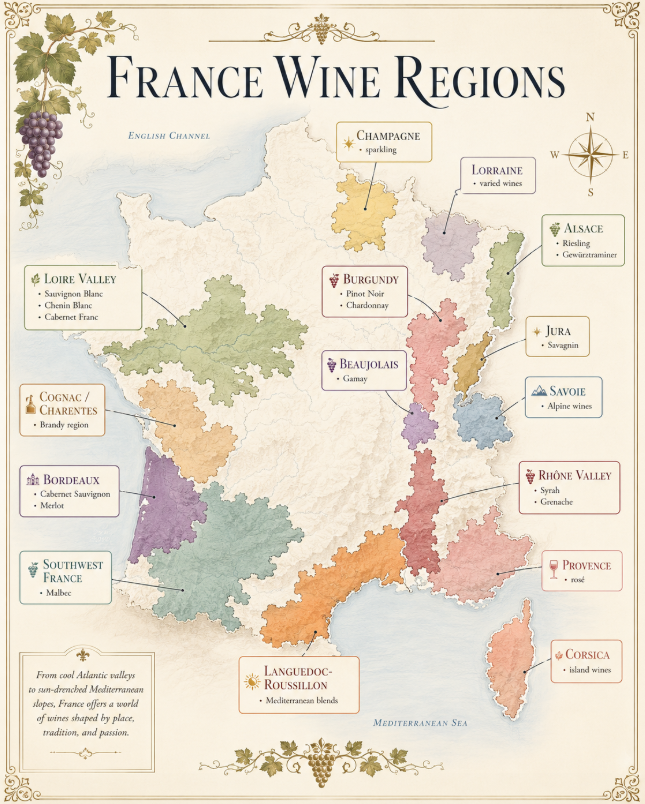
France is one of the world’s great wine countries, not only because of its famous names, but because each region expresses a very distinct sense of place. From the cool chalk soils of Champagne to the sun-drenched vineyards of Provence and the gravelly banks of Bordeaux, French wine is shaped by grape variety, climate, soil and tradition.
Bordeaux, in southwest France, is best known for elegant, structured red blends. The key grape varieties are Cabernet Sauvignon, Merlot, Cabernet Franc, Petit Verdot and Malbec. On the Left Bank, gravel soils help retain heat and suit Cabernet Sauvignon, producing powerful wines with blackcurrant, cedar, tobacco and graphite notes. On the Right Bank, clay and limestone soils favour Merlot and Cabernet Franc, creating softer, rounder wines with plum, spice and velvety texture. The climate is maritime, influenced by the Atlantic Ocean, which brings mild winters, humid conditions and a long growing season. This allows Bordeaux wines to develop both freshness and complexity.
Burgundy is the home of purity and precision. The region focuses mainly on Pinot Noir for red wines and Chardonnay for white wines. Its vineyards are famously divided into small plots, where tiny changes in slope, soil and exposure can create very different wines. The climate is continental, with cold winters, warm summers and a real risk of frost. Limestone and clay soils dominate, giving Burgundy its signature elegance, minerality and finesse. Pinot Noir from Burgundy is delicate, perfumed and silky, while Chardonnay can range from crisp and mineral in Chablis to rich and textured in Meursault or Puligny-Montrachet.
Champagne is France’s most iconic sparkling wine region. Its main grapes are Chardonnay, Pinot Noir and Pinot Meunier. The cool climate preserves high acidity, which is essential for freshness, ageing potential and fine sparkling wine. The region’s famous chalky soils help with drainage while retaining moisture, allowing vines to survive in a marginal climate. Chardonnay brings elegance and citrus freshness, Pinot Noir adds structure and depth, while Pinot Meunier contributes fruitiness and softness.
The Loire Valley is one of France’s most diverse wine regions, stretching from the Atlantic coast to central France. Its key grapes include Sauvignon Blanc, Chenin Blanc, Melon de Bourgogne, Cabernet Franc and Pinot Noir. The climate varies from maritime in the west to more continental inland. Soils are equally varied, including limestone, flint, clay, schist and gravel. Sancerre and Pouilly-Fumé are famous for crisp Sauvignon Blanc with citrus, green apple and mineral notes. Vouvray produces Chenin Blanc in dry, sweet and sparkling styles, while Chinon and Saumur are known for fresh, elegant Cabernet Franc.
The Rhône Valley is divided into the cooler north and the warmer south. In the Northern Rhône, Syrah is the star red grape, producing wines with black fruit, violet, pepper and smoky notes. Whites are made from Viognier, Marsanne and Roussanne. The soils are often granite-based, and the steep slopes help capture sunlight in a cooler continental climate. The Southern Rhône has a warmer Mediterranean climate and is known for blends based on Grenache, Syrah and Mourvèdre. The soils often include clay, limestone, sand and the famous rounded stones of Châteauneuf-du-Pape, which absorb heat during the day and release it at night. The wines are generous, spicy and full of ripe red fruit.
Alsace sits close to the German border and is famous for aromatic white wines. The key grapes are Riesling, Gewürztraminer, Pinot Gris, Muscat and Sylvaner, with some Pinot Noir also produced. The Vosges Mountains protect the vineyards from rain, making Alsace one of the driest wine regions in France. The climate is sunny and continental, allowing grapes to ripen fully while retaining freshness. Soils are highly varied, including granite, limestone, clay, sandstone and volcanic formations. Alsace wines are often expressive, floral, precise and beautifully aromatic.
Provence is the spiritual home of elegant rosé. The main grape varieties include Grenache, Cinsault, Syrah, Mourvèdre, Rolle and Tibouren. The climate is Mediterranean, with warm sunshine, dry summers and cooling sea breezes. The soils are often limestone, clay, schist and sandstone, helping create wines with freshness, pale colour and delicate flavours of strawberry, peach, citrus and herbs. Provence rosé is known for its refined, dry and graceful style.
Languedoc-Roussillon is one of France’s largest and most exciting wine areas. It produces reds, whites, rosés and sparkling wines with excellent diversity. Important grapes include Grenache, Syrah, Mourvèdre, Carignan, Cinsault, Picpoul, Marsanne, Roussanne and Grenache Blanc. The climate is warm and Mediterranean, with dry summers and cooling winds that help keep the grapes healthy. Soils range from limestone and clay to schist, sandstone and gravel. The wines are often expressive, generous and full of southern French character.
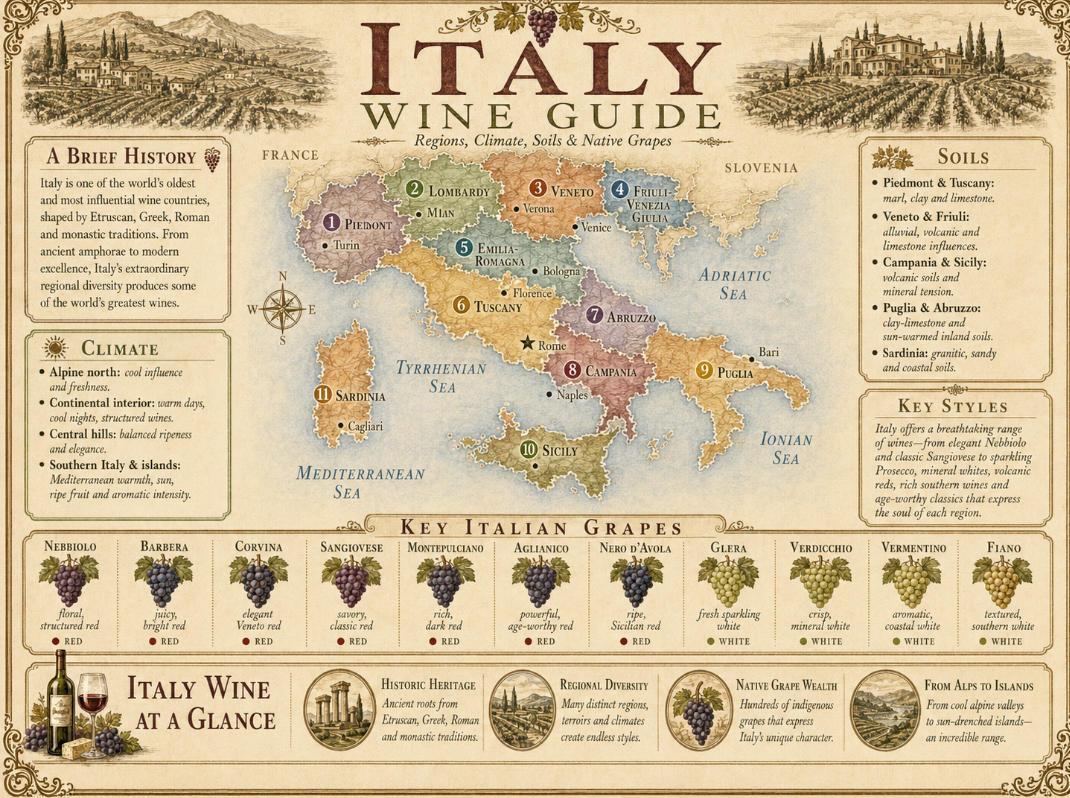
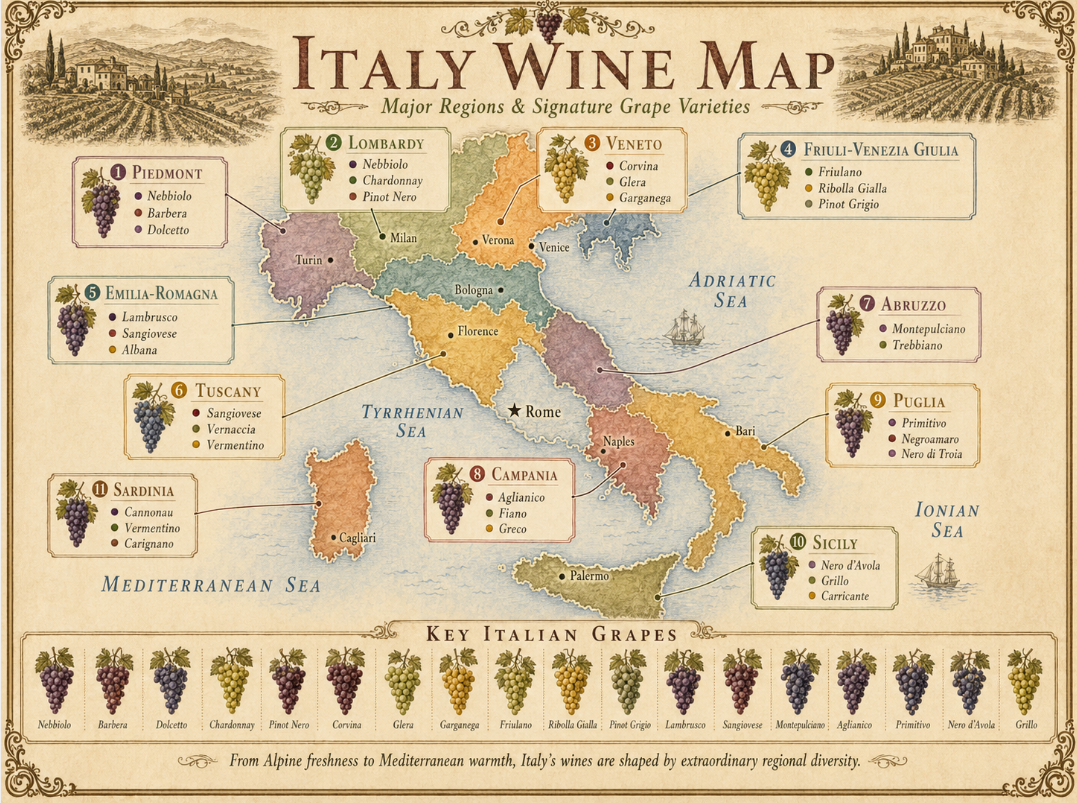
Italy is one of the world’s most important wine countries, with a history shaped by Etruscan, Greek, Roman and monastic traditions. Wine is produced in every part of the country, from the Alpine north to the sun-drenched islands of Sicily and Sardinia. What makes Italian wine so fascinating is its regional diversity: every area has its own grapes, climate, food culture and personality.
Italy is especially famous for its native grape varieties. The country has hundreds of indigenous grapes, giving its wines a very distinctive identity. Instead of one single “Italian style”, there are many: elegant Nebbiolo from Piedmont, savoury Sangiovese from Tuscany, bright Barbera, rich Aglianico, volcanic Sicilian reds, crisp coastal whites and sparkling Prosecco.
Italy’s climate changes dramatically from north to south. In the north, regions such as Piedmont, Lombardy, Veneto and Friuli have cooler influences from the Alps. This helps create wines with freshness, structure and elegance.
In the central hills, especially Tuscany, Umbria and Abruzzo, warm days and cooler nights give balance, ripeness and acidity. These regions are ideal for structured reds and food-friendly wines.
In the south and islands, including Campania, Puglia, Sicily and Sardinia, the Mediterranean climate brings sunshine, warmth and ripe fruit. These wines can be generous and powerful, but coastal breezes and altitude often keep them fresh.
Italian soils are incredibly varied. Piedmont and Tuscany often have marl, clay and limestone, which help produce structured and age-worthy reds. Veneto and Friuli have alluvial, limestone and volcanic influences. Campania and Sicily are known for volcanic soils, giving wines mineral tension and energy. Puglia and Abruzzo often have clay-limestone and sun-warmed inland soils, while Sardinia has granitic, sandy and coastal soils. This diversity is one reason Italian wines feel so connected to place.
Key Italian Red Grapes
Nebbiolo is the noble grape of Piedmont, used in Barolo and Barbaresco. It produces elegant, structured wines with rose, cherry, tar, spice and firm tannins.
Sangiovese is the heart of Tuscany, found in Chianti Classico and Brunello di Montalcino. It gives savoury reds with cherry, herbs, leather, earth and bright acidity.
Barbera is juicy, fresh and bright, often with red fruit and lively acidity. It is one of Piedmont’s most approachable and food-friendly reds.
Corvina is the key grape of Valpolicella and Amarone in Veneto. It creates elegant reds with cherry, spice and, in Amarone, richness and dried-fruit depth.
Montepulciano is especially important in Abruzzo. It produces dark, generous reds with plum, black cherry and soft spice.
Aglianico, grown in Campania and Basilicata, is powerful, tannic and age-worthy, often showing dark fruit, smoke, earth and spice.
Nero d’Avola is Sicily’s famous red grape, giving ripe, warm, dark-fruited wines with Mediterranean character.
Key Italian White Grapes
Glera is the grape behind Prosecco, producing fresh, light sparkling wines with pear, apple and floral notes.
Verdicchio, from Marche, is crisp, mineral and often quietly complex, with citrus, almond and saline notes.
Vermentino, found in Sardinia, Liguria and coastal Tuscany, gives aromatic, refreshing whites with citrus, herbs and sea-breeze freshness.
Fiano, especially from Campania, produces textured southern whites with pear, honey, nuts, flowers and mineral depth.
Pinot Grigio is widely grown in northern Italy and makes light, fresh, easy-drinking whites, especially in Veneto and Friuli.
Style of Italian Wine; Italian wine is deeply connected to food, place and tradition. The reds often have acidity, structure and savoury character, making them beautiful with meals. The whites can be crisp, mineral, aromatic or textured, depending on the region.
From Barolo and Brunello to Prosecco, Amarone, Etna Rosso and Vermentino, Italy offers an extraordinary range of wines. Its beauty lies in variety: elegant, rustic, polished, ancient, modern, coastal, alpine, volcanic and deeply expressive.
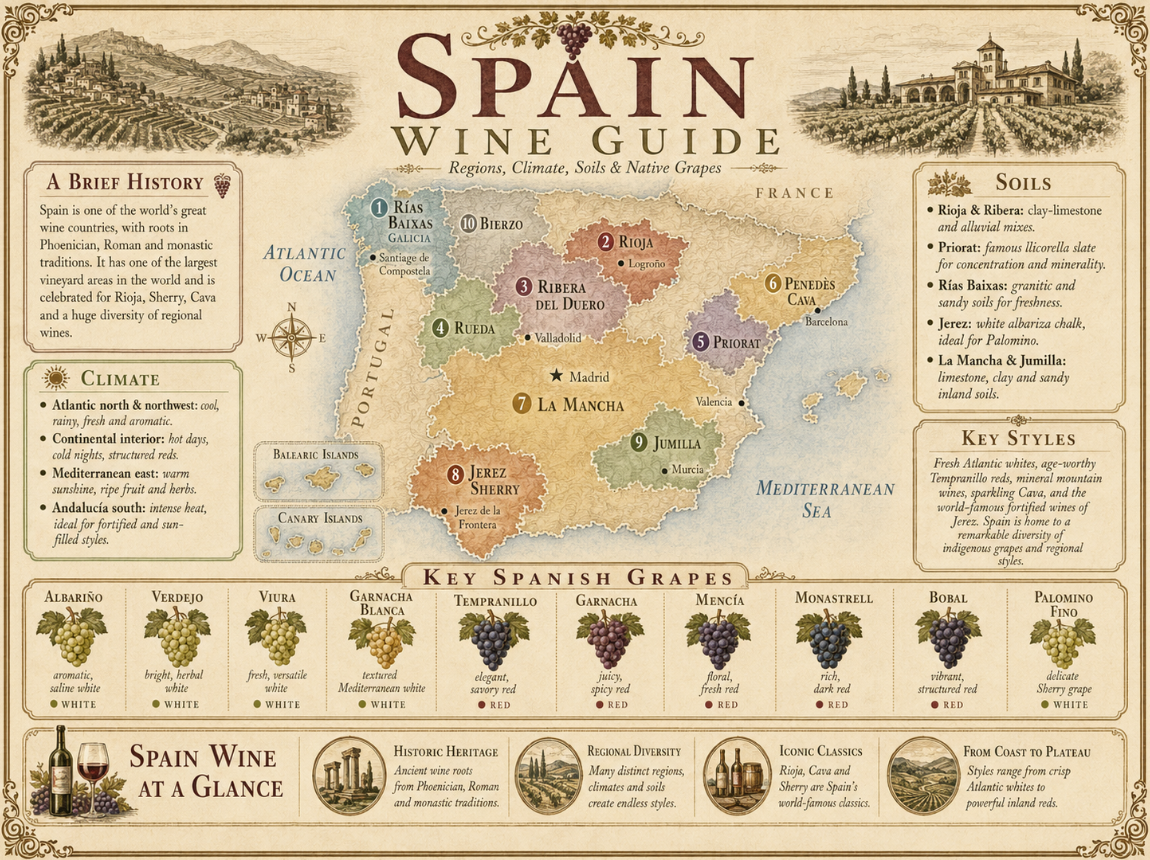
Spain is one of the great wine countries of the world, with a history shaped by Phoenician, Roman and monastic traditions. Today it is known for its remarkable diversity: elegant reds, fresh Atlantic whites, sparkling Cava, fortified Sherry, Mediterranean styles and powerful inland wines. Spain has many protected wine regions, each with its own climate, soils and grape traditions.
The climate varies dramatically. In the north and northwest, Atlantic influence brings cool, wet conditions, giving wines freshness, acidity and aromatic lift especially in Rías Baixas, known for Albariño. In the continental interior, regions such as Ribera del Duero, Rueda and La Mancha experience hot days and cold nights, helping produce structured reds and fresh whites. Along the Mediterranean east, areas such as Priorat, Penedès and Jumilla are warmer, producing ripe, expressive wines. In Andalucía, intense heat supports the unique fortified wines of Jerez / Sherry.
Spain’s soils are equally important. Rioja and Ribera del Duero are known for clay, limestone and alluvial soils, which support structured, age-worthy reds. Priorat is famous for its dark slate soil, called llicorella, giving powerful wines with concentration and minerality. Rías Baixas has granitic and sandy soils that suit fresh, saline whites, while Jerez is defined by white albariza chalk, ideal for Palomino and Sherry production.
Spain’s most famous red grape is Tempranillo, the heart of Rioja and Ribera del Duero. It produces elegant, savoury wines with red fruit, spice, leather and ageing potential. Garnacha brings juicy red fruit, warmth and spice, especially in areas such as Priorat and Aragón. Monastrell, important in Jumilla, gives dark, rich, powerful reds. Mencía, from the northwest, is lighter and more floral, while Bobal produces vibrant, structured reds.
For whites, Albariño is Spain’s star Atlantic grape; aromatic, citrusy, saline and refreshing. Verdejo, especially from Rueda, is bright, herbal and crisp. Viura, also known as Macabeo, is important in Rioja and Cava, while Garnacha Blanca gives textured Mediterranean whites. Palomino Fino is the essential grape of Sherry, producing delicate wines that become complex through ageing and flor.
Spanish wine is full of contrast: fresh coastal whites, savoury aged reds, mineral mountain wines, sparkling Cava and the extraordinary fortified wines of Jerez. It is a country of warmth, history and personality generous, expressive and endlessly rewarding to explore.
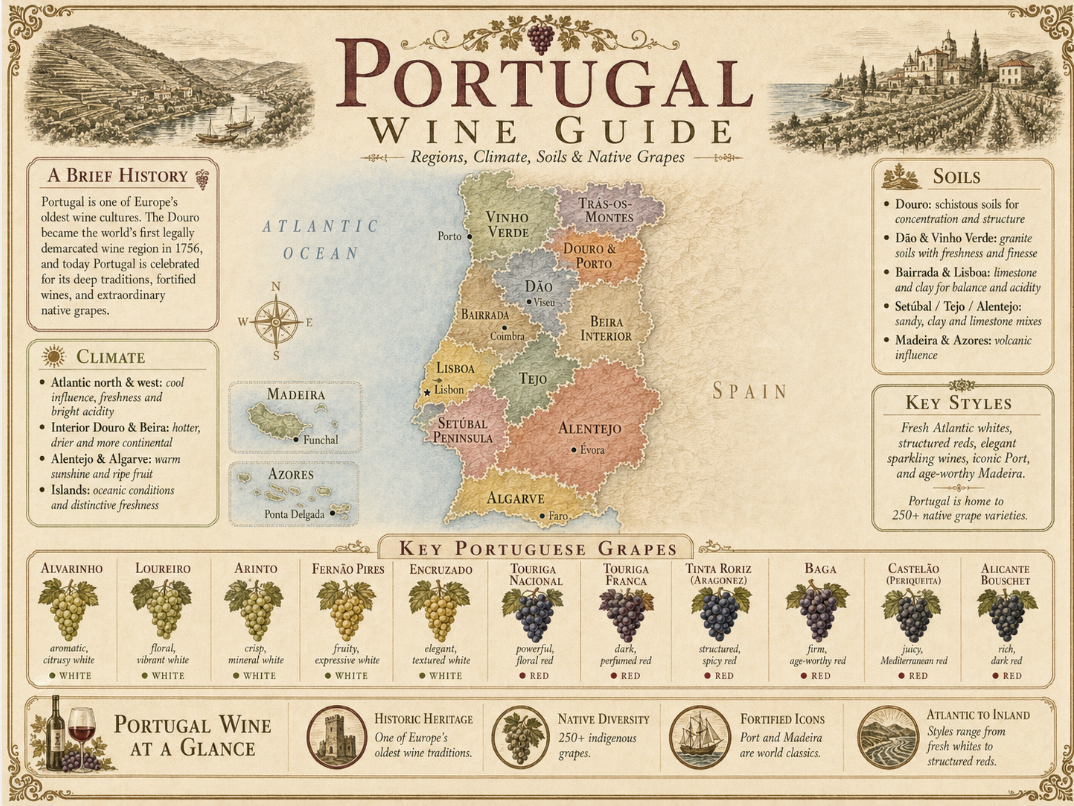
Portugal is one of Europe’s most characterful wine countries, known for its historic traditions, native grape varieties and remarkable regional diversity. Beyond its famous Port and Madeira, Portugal produces fresh whites, structured reds, elegant sparkling wines and distinctive volcanic island wines.
One of Portugal’s greatest strengths is its grape heritage. The country is home to 250+ native grape varieties, giving its wines a strong identity and a style that often feels different from the rest of Europe.
The climate changes from region to region. In the north and west, Atlantic influence brings freshness and bright acidity, especially in Vinho Verde. Inland regions such as the Douro and Beira Interior are hotter and drier, producing deeper, more structured reds. In the south, Alentejo and the Algarve offer warmer, riper, more generous wines.
Portugal’s soils are equally diverse. The Douro is famous for steep vineyards and schist soils, which help create concentrated wines and classic Port. Dão is known for granite soils and elegant wines, while Bairrada has clay and limestone soils, ideal for age-worthy reds and sparkling wines. Madeira and the Azores bring volcanic influence and Atlantic freshness.
Key red grapes include Touriga Nacional, powerful and floral; Touriga Franca, dark and perfumed; Tinta Roriz, structured and spicy; Baga, firm and age-worthy; Castelão, juicy and Mediterranean; and Alicante Bouschet, rich and deeply coloured.
Important white grapes include Alvarinho, aromatic and citrusy; Loureiro, floral and fresh; Arinto, crisp and mineral; Fernão Pires, fruity and expressive; and Encruzado, elegant and textured.
Portuguese wine is full of contrast: fresh Atlantic whites, bold inland reds, refined sparkling wines, iconic fortified classics and rare native grapes. It is historic, soulful and quietly sophisticated — a beautiful country for anyone who loves wines with personality.
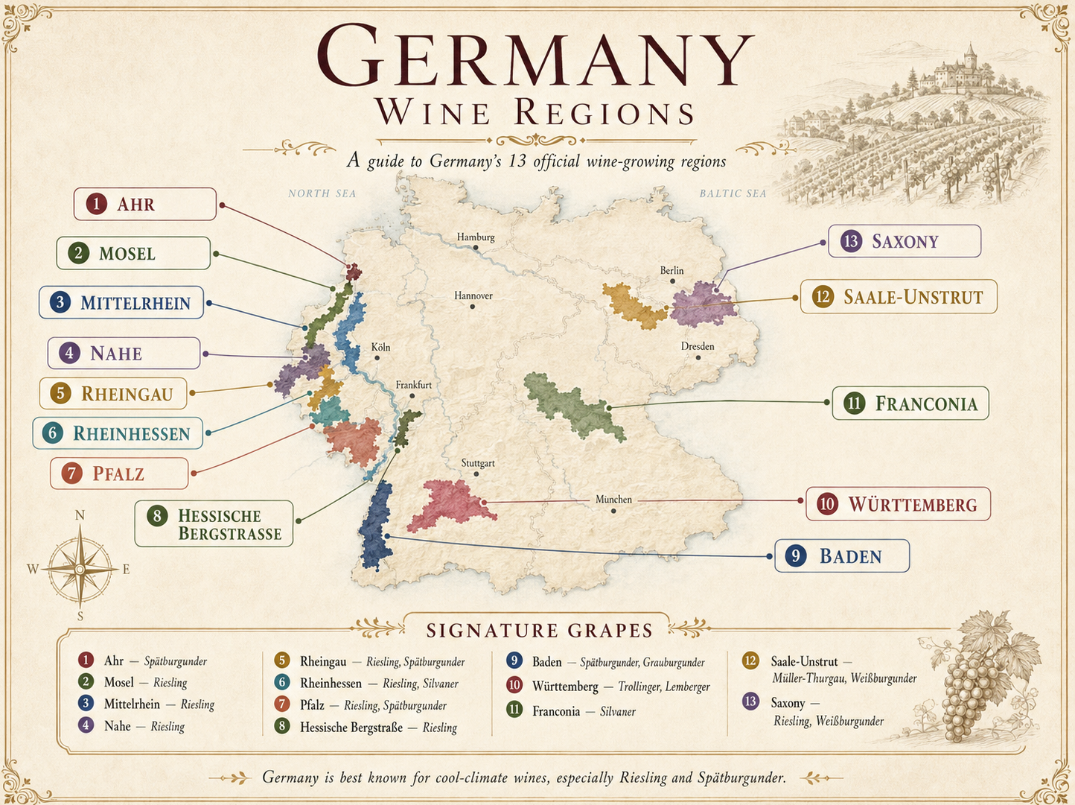
Germany is one of the world’s most distinctive cool-climate wine countries, known for wines of freshness, elegance and precision. Its vineyards are spread across 13 official wine-growing regions, mostly in the south and southwest, with two historic regions, Saale-Unstrut and Saxony, further east.
The country’s cool climate is central to its style. Grapes ripen slowly over a long growing season, preserving bright acidity while developing delicate aromas. This gives German wines their beautiful lift: crisp citrus, stone fruit, flowers, herbs, minerality and a sense of purity rather than heaviness.
Many of Germany’s finest vineyards sit along rivers such as the Mosel, Rhine, Nahe and Main. These rivers moderate temperatures, reflect light onto the vines and help protect vineyards from extreme cold. Steep slopes are also essential, especially in regions like the Mosel, Mittelrhein and Ahr, where vines cling to dramatic hillsides to capture as much sunlight as possible.
Soil is another key part of Germany’s identity. Slate in the Mosel gives Riesling its famous mineral, smoky and delicate character. Limestone, loess and clay in regions such as Baden, Pfalz and Rheinhessen support richer, more textured wines. In Franconia, limestone soils are closely linked with structured, savoury Silvaner, while the Nahe is known for its remarkable mix of soil types, giving its wines great complexity.
Germany’s signature grape is Riesling. It is expressive, precise and incredibly versatile, producing everything from bone-dry wines to delicate off-dry styles, sparkling wines and some of the world’s most beautiful sweet wines. German Riesling often shows notes of lime, green apple, peach, apricot, white flowers, honey and wet stone.
Germany is also increasingly admired for Spätburgunder, the German name for Pinot Noir. Regions such as Ahr, Baden, Pfalz and Rheingau produce elegant, silky reds with red cherry, raspberry, spice and subtle earthy notes.
Other important grapes include Silvaner, especially in Franconia; Grauburgunder and Weißburgunder, which bring texture, softness and food-friendly elegance; Müller-Thurgau, known for fresh, easy-drinking whites; and regional reds such as Trollinger and Lemberger in Württemberg.
German wine is often misunderstood as only sweet, but today it is one of the most exciting countries for dry whites, refined Pinot Noir, sparkling Sekt and age-worthy Riesling. Its beauty lies in contrast: delicacy with depth, freshness with complexity, and quiet elegance with remarkable expression of place.
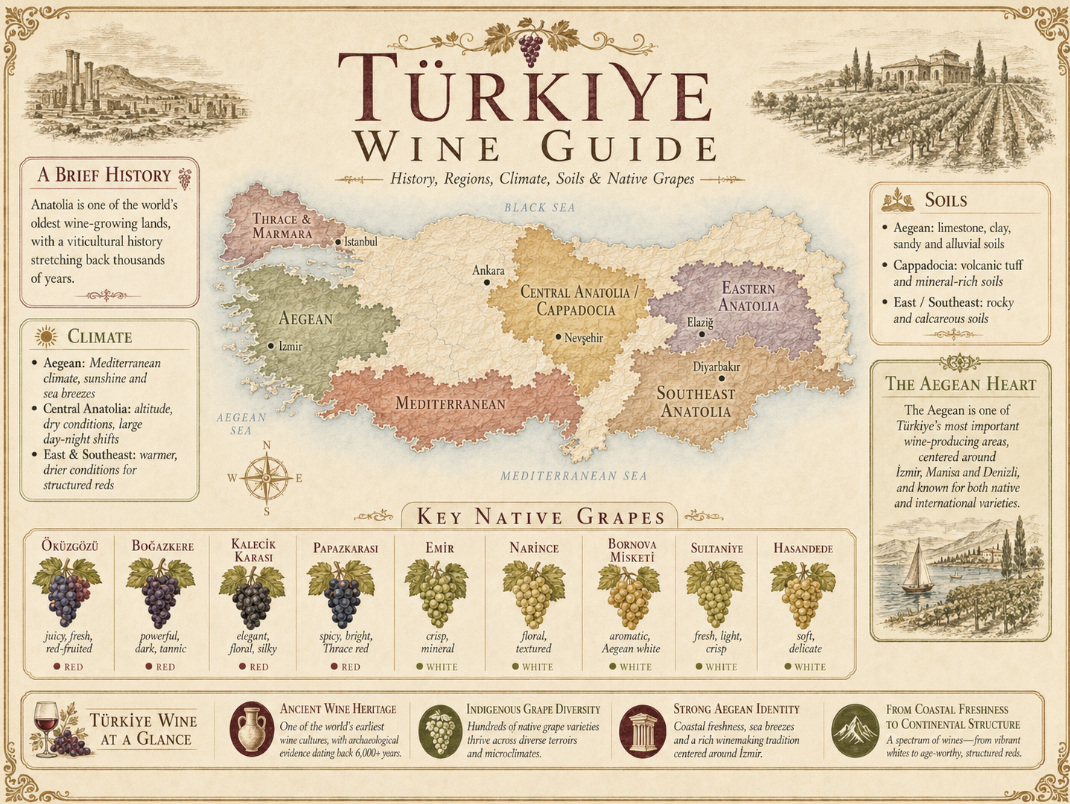
Türkiye is one of the oldest wine-growing lands in the world, with a history rooted in Anatolia’s ancient vineyards, trade routes and civilisations. Long before wine became associated with the classical regions of Europe, grapes were being cultivated across these lands - from the Aegean coast to Central Anatolia and the eastern valleys. Today, Turkish wine is experiencing a quiet renaissance, led by thoughtful producers, native grape varieties and a growing appreciation for the country’s remarkable diversity.
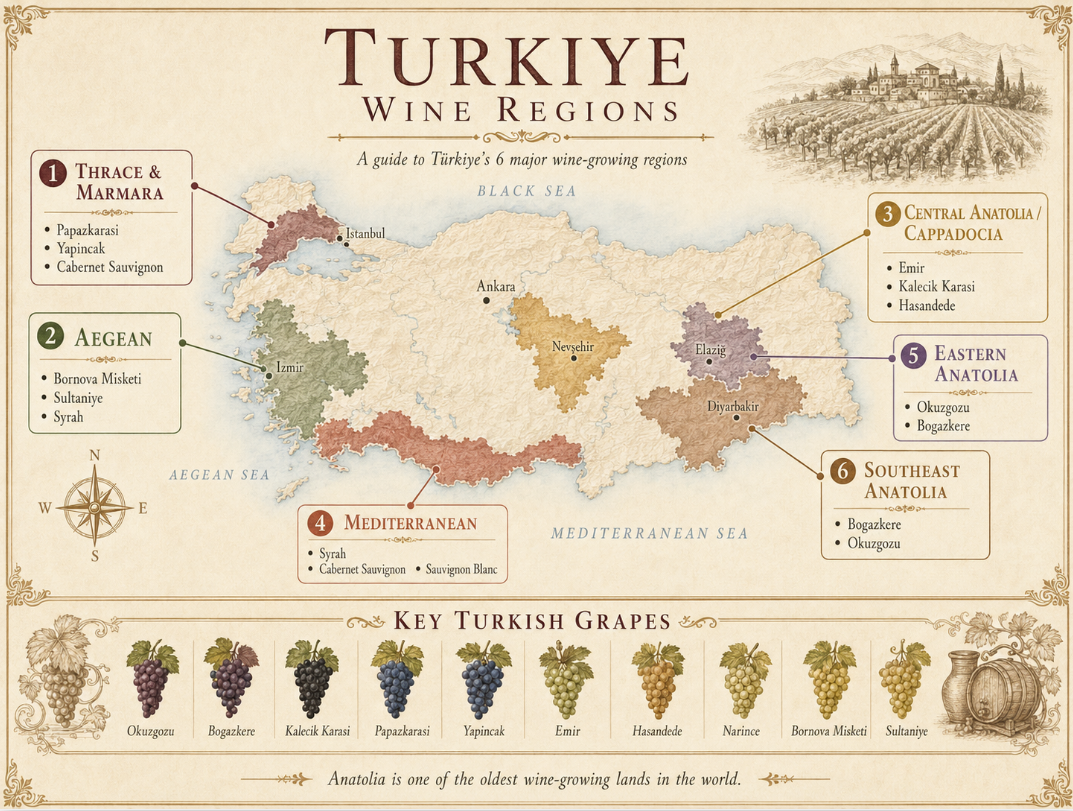
For me, this story is personal. My family’s wine heritage comes from the Aegean part of Türkiye, a region shaped by sea air, sunshine, olive groves, ancient cities and generous vineyards. The Aegean is one of Türkiye’s most important wine-producing areas, with key zones around İzmir, Manisa and Denizli, as well as coastal and inland vineyard routes. (wsetglobal.com)
Climate;Türkiye’s wine regions are incredibly varied. The Aegean has a Mediterranean climate, with warm summers, cooling breezes and bright sunlight. This helps produce ripe, expressive wines with freshness and aromatic character.
Further inland, Central Anatolia and Cappadocia are shaped by altitude, dry conditions and dramatic day-to-night temperature shifts. These cooler nights help preserve acidity and elegance in the grapes. In the east and southeast, warmer, drier conditions create structured, intense reds with depth and spice.
Soil; The soils of Türkiye are as diverse as its landscapes. In the Aegean, vineyards can be found on limestone, clay, sandy and alluvial soils, often influenced by the nearby sea and surrounding mountains. These conditions support both native grapes and international varieties.
In Cappadocia, volcanic soils give wines a distinctive mineral character, especially whites made from Emir. In eastern regions such as Elazığ and Diyarbakır, rocky and mineral-rich soils help produce powerful reds from Öküzgözü and Boğazkere.
Native Turkish Grape Varieties
One of the most exciting things about Turkish wine is its native grapes. These varieties carry the identity of the land and give Turkish wine its originality.
Öküzgözü is one of Türkiye’s most loved red grapes. It produces elegant, fruit-driven wines with red cherry, raspberry, soft tannins and refreshing acidity.
Boğazkere is deeper and more powerful, known for dark fruit, firm tannins, spice and structure. It is often blended with Öküzgözü to create balanced, age-worthy reds.
Kalecik Karası is a graceful red variety from Central Anatolia, often compared in style to lighter, aromatic reds. It can show red berries, flowers, spice and silky texture.
Papazkarası, traditionally associated with Thrace and Marmara, produces characterful reds with freshness, spice and earthy notes.
Emir, from Cappadocia, is a delicate white grape known for citrus, green apple, minerality and crisp acidity.
Narince produces fuller, textured whites with pear, citrus, floral notes and sometimes a gentle savoury quality.
Bornova Misketi, closely linked with the Aegean, is beautifully aromatic, showing orange blossom, citrus peel, flowers and grapes. It is one of the region’s most charming white varieties.
Sultaniye, also important in the Aegean, can make fresh, light and easy-drinking white wines.
International Grapes in Türkiye
Alongside native varieties, Türkiye also produces excellent wines from international grapes such as Syrah, Cabernet Sauvignon, Merlot, Chardonnay and Sauvignon Blanc. In the Aegean especially, Syrah and Cabernet Sauvignon can produce ripe, polished reds, while white varieties benefit from coastal freshness.
New World wine regions offer a beautiful contrast to the classical traditions of Europe. They are expressive, adventurous, and often shaped by dramatic landscapes; ocean winds, mountain altitude, volcanic soils, desert heat, and long, luminous summers.
These wines tend to speak with clarity and confidence. They can be generous and fruit-driven, but also refined, mineral, structured, and deeply elegant. From the cool coastal vineyards of California and Chile to the high-altitude estates of Argentina, the old vines of Australia, and the pristine landscapes of New Zealand, the New World has created some of the most exciting wines being poured today.
United States
The United States is one of the most influential New World wine countries, with California at its heart. Napa Valley is known for powerful, polished Cabernet Sauvignon, while Sonoma offers elegance, diversity, and beautiful expressions of Chardonnay and Pinot Noir. Further north, Oregon has become one of the world’s most admired regions for refined, cool-climate Pinot Noir.
American wine is confident and expressive. At its best, it combines richness with precision — wines that feel modern, luxurious, and full of character.
Canada
Canada may be best known for its exquisite Icewine, but its still wines are increasingly serious and refined. Ontario’s Niagara Peninsula and British Columbia’s Okanagan Valley produce elegant Riesling, Chardonnay, Pinot Noir, Cabernet Franc, and Syrah.
There is a purity to Canadian wine: fresh acidity, cool-climate restraint, and a quiet sophistication that makes the wines feel graceful and precise.
Mexico
Mexico has one of the oldest wine histories in the Americas, yet it still feels exciting and undiscovered. Baja California, especially Valle de Guadalupe, has become the country’s leading wine region, producing bold reds, textured whites, and Mediterranean-style blends.
Mexican wines often feel warm, expressive, and sensual — shaped by sun, sea air, and a growing generation of creative producers.
Chile
Chile is a country of natural extremes, bordered by the Pacific Ocean, the Andes Mountains, the Atacama Desert, and Patagonia. This geography creates ideal conditions for fresh, expressive wines with purity and balance.
Carménère is Chile’s signature red, while Cabernet Sauvignon, Syrah, Sauvignon Blanc, and Pinot Noir also thrive. From the cool Casablanca and Leyda Valleys to the powerful reds of Maipo and Colchagua, Chile offers wines with both elegance and depth.
Argentina
Argentina is defined by altitude, sunlight, and the dramatic beauty of the Andes. Mendoza is its most famous region, producing Malbecs that are rich, velvety, and deeply seductive, often balanced by freshness from high-elevation vineyards.
Beyond Malbec, Argentina also produces beautiful Cabernet Franc, Torrontés, Chardonnay, and sparkling wines. These are wines with presence — generous, atmospheric, and full of energy.
Uruguay
Uruguay is one of South America’s most intriguing wine countries. Its signature grape is Tannat, a deeply coloured red variety that produces structured, intense wines with dark fruit, spice, and firm tannins.
The country’s Atlantic influence brings freshness and balance, giving Uruguayan wines a distinctive personality. They are bold but not heavy, rustic yet increasingly refined.
Brazil
Brazil’s wine scene is vibrant and evolving, with a particular strength in sparkling wine. The Serra Gaúcha region in the south is the heart of production, where cooler conditions help create fresh, lively wines.
Brazilian sparkling wines are bright, elegant, and full of charm. They bring a sense of celebration and ease — ideal for anyone looking to discover something different and beautifully uplifting.
South Africa
South Africa sits between Old World heritage and New World energy. Its wine history is centuries old, but its modern wines feel dynamic, expressive, and increasingly refined.
Stellenbosch is known for Cabernet Sauvignon, Bordeaux-style blends, and Chenin Blanc, while Swartland has become famous for old vines, natural texture, and soulful, characterful wines. South African wine often has a beautiful tension: ripe fruit, savoury depth, and a distinctive mineral edge.
Australia
Australia is one of the great New World wine powers, producing everything from bold, iconic Shiraz to elegant Chardonnay, Cabernet Sauvignon, Riesling, and Pinot Noir.
Barossa Valley is known for rich, powerful reds, while Margaret River offers polished Cabernet and refined Chardonnay. Tasmania and Yarra Valley show a cooler, more delicate side of Australian wine. It is a country of contrast — sunlit, generous, and full of personality, but capable of great finesse.
New Zealand
New Zealand has become globally loved for its vibrant Sauvignon Blanc, especially from Marlborough, but there is far more to discover. Central Otago produces seductive Pinot Noir, while Hawke’s Bay is known for Syrah and Bordeaux-style blends.
New Zealand wines are often bright, pure, and aromatic, with a natural elegance shaped by cool climates and maritime influence. They feel fresh, precise, and beautifully alive.